The movement stabilization system provides a stable platform upon which intentional movements are performed. It stabilizes balance, limbs, and muscle tensions by sensing unintentional movement [perturbations], and executing muscle memories [motor skills], that generate countervailing forces [muscle contractions].
The platform is stable because unwanted movement is blocked
But when the stabilization system fails to do its job, or worse yet cause rather than prevent unintended movement, all movement is in disorder.
It is virtually impossible to perform normal motor skills upon an unstable platform
Stabilization may be restored by restoring aberrant muscle memories. STABLEX [SX] therapy is based on the universally accepted fact that voluntary muscle memories may be improved with practice and the yet to be accepted fact that reflexes execute muscle memories that may likewise be improved.
STABLEX restores stabilization and
voluntary motor skills are re-adapted to a stable platform
STABLEX OVERVIEW
Discovery
Dan held out his hands and asked me to look at them. They had no tremor. He then squatted and quickly stood up. He did not lose his balance. His speech was steady, clear and strong. His Parkinson Disease symptoms were nowhere to be seen. He told me his symptoms “disappeared for 24 hours following his power-sanding of a wood chair for 30 minutes and that switching left to right hands with pressure seemed to have the most effect”. He said, “I have repeated this 8 times over a two-month period with the same results”.
Dan power sanded his PD symptoms away
I was baffled. First, the disappearance of symptoms continued for a protracted period. That meant changes to Dan occurred. Second, all movements and apparently cognitive disorders ceased. That indicated the effect was systemic. Third, there must be something unique about Dan’s experience; else:
Millions of people would be power sanding chairs
The STABLEX Project
I commenced what turned out to be a never-ending and all-consuming research project involving extensive research, designing and building six experimental devices, recruiting participants with movement disorders, performing numerous training sessions over protracted periods, collecting thousands of measurements and contemporaneous observations, recording before and after videos, formulating hypothesis based on accepted scientific facts and theories, obtaining several patents for hand-held and wearable devices and developing a website, www.TREMOREX.com, featuring this body of work, all with the objective of developing a device and strategy that restores stabilization the way stabilization is naturally restored.
Results: Unprecedented & Persistent A research and feasibility project involving six participants yielded the following average results redefining what is possible in stable movement restoration:
- Immediate Impact: The FIRST training session of 5 to 15 minutes reduced tremors by 96% for 18 to 40 hours.
- Cumulative Healing:As sessions were conducted when tremors returned, the interval of stability progressively lengthened—from days to months, and potentially permanently.
- Systemic Restoration:Beyond tremors, STABLEX stabilizes balance, gait, rigidity, freezing, “masked face” (hypomimia) and frees the brain to think rather than compensate for instability.
- Four videos and “MORE” are a must see and may be accessed on the website Home page. tremorex.com
- Subject Improvement describes the methodology, measurements and analysis for six participants in the website page. https://tremorex.com/subject-improvement/
When has anyone ever seen such restoration?
NEVER! It has never happened before STABLEX!
BACKGROUND
Modern medicine
For over two centuries medical therapies have evolved to modulation of neurotransmission [drugs, implants, artificial stimulation], ablation [destruction] of brain tissue, paralyzing muscles [Botox], and physical therapy [alternative movements] that mitigate and/or manage symptoms.
- Drugs are the best-known medical therapy for mitigation of movement disorder symptoms. However, in addition to disastrous side effects and drug dependency issues, they can cause movement disorders. Levodopa and dopamine agonists are known to cause proprioception deficits and drug induced dyskinesia. In general, a drug taken to mitigate one symptom is likely to exacerbate other symptoms. For example, the same drug, beta blockers, used to suppress Essential Tremors, is used to limit blood pressure. One cannot treat one without inadvertently treating the other.
Unintended treatments are called side effects.
Drugs modulate to “help” or “substitute” natural [endogenous] processes but adversely cause them to become even more incapable. Itisnotunlikeperpetuallyusingawheelchair to ambulate in lieu of walking. Walking gets weaker, atrophies, and is forgotten.
Use it or lose it.
- Deep Brain Stimulation [DBS] requires a surgically implanted pacemaker type device. Experts are unclear how DBS works, but by sending high frequency electrical impulses into specific areas of the brain to “disrupt faulty brain signals” and mitigate symptoms. DBS is regarded as a last resort means of mitigating symptoms.
- Electrical stimulation of nerve fibers is a non-invasive, wearable device that stimulates nerve fibers of a specific limb [hand] to mitigate tremors and resembles DBS mechanism of action [disrupt faulty brain signals].
- Ablation non-reversable destruction of brain cells now performed non-invasively with MRI guided Ultrasound.
- Paralyze muscles – Botox injections target and paralyze specific muscles intentionally mitigating unintended movement [tremors] and unintentionally weakening voluntary movement as the same motor neurons and muscles are used for both.
- Vibration devices commenced in the 19th century when Jean-Martin Charcot, known as “the founder of modern neurology,” observed his patients experienced movement disorder [parkinsonian symptoms] improvement after riding in horse and buggy carriage. He developed a vibrating chair to treat his patients. Over the years, a plethora of devices have been developed like vibrating helmets, whole body vibration platforms, vibrating treadmills, and vibrating wearable devices. However, vibration therapy has been clinically evaluated and whereas it may increase blood circulation, reduce swelling, alleviate muscle pain and promote relaxation, its effectiveness in mitigating movement disorders is likely due to placebo effects rather than the vibration itself.
- People automatically rehabilitate by adopting compensatory strategies. For example, irregular posture and movement is assumed to avoid falling. People crouch or lean forward, outstretch hands, position feet apart, and avoid unnecessary movement to keeptheircenterofgravitylowandoveralargebaseofTheydeploydefensive movements like moving slowly, avoiding sharp turns, and walking backwards. They shuffle their feet while walking so that both feet are always in contact with the floor. Freezing reducestheriskoffalling.Otherstrategiesincludebehavioralchangeslike avoidance of difficult motor skills and movements. For example, do not stand to avoid falling, have someone elsethread theneedle andperform othermotor skills beyond theircapability.
- Physical Therapy centers on exercises, devices, and education that improve a person’s strength, flexibility, range of motion, endurance and coordination, thereby improving a person’s ability to move more safely, confidently, and perform everyday activities. Patients are trained to perform challenging maneuvers like Tai Chi, execution of fine motor skills like placing pegs in a pegboard, how to compensate for imbalance, and how to use assistive devices that provide alternatives to normal movement. For example, braces, crutches, walkers, and wheelchairs provide functional alternatives to normal walking. Handheld or worn devices target specific symptoms like tremor or balance deficits and provide damping or offsetting forces that countervail unintended movement.
- Training Devices help train people to use alternative biological methods of mitigating symptoms. For example, a device perturbs a user’s balance, and the user learns how to anticipate and prepare for it by tensing muscles, assuming defensive postures and responding with voluntary compensatory movements that are reactions rather than automatic reflexes. Such training teaches people how to improve voluntary reactions instead of automatic reflexes.
COMPENSATORY STRATEGIES
Whether adapted automatically or as a prescribed treatment, modern medicines are compensatory strategies that do not restore stable movement. They provide symptom relief at the expense of systemic side effects, dependency issues, and long-term maladapted [negative] plasticity of natural mechanisms.
Abnormal environments maladapt natural mechanisms
For example, aberrant stabilization, [abnormal environment] causes voluntary muscle memories to become aberrant because they attempt to adapt to an unstable platform.
Aberrant environment = Aberrant movement
Furthermore, training and use of voluntary movement to compensate for deficit automatic movement diverts cognitive resources from thinking to control of movement normally handled by the stabilization system. Movement is slow, staccato, deliberate, and carefully planned as muscle contractions are consciously rather than automatically controlled. When the brain becomes preoccupied with micromanaging stabilization, cognitive demands must wait. That is why people with movement disorders appear to not being able to walk and talk at the same time.
Diversion of cognitive resources has consequences.
In another example, using assistive devices like a cane or walker reduces and modifies demand on neurons, muscles, and muscle memories, causing them to atrophy and muscle memories to maladapt to an abnormal way of walking.
Maladapted muscle memories become the new “norm”
Compensatory strategies may mitigate movement disorder symptoms but, paradoxically, the more effective they are, the more they exacerbate natural capabilities to adapt to normal environments.
Compensatory strategies cause maladapted plasticity
BIOLOGICAL SYSTEMS
Compensatory strategies may be the only recourse for some people however, biological systems can heal themselves
Restoration is a form of self-healing
Biological systems can adapt to environmental conditions, be trained, and thereby restored.
Plasticity makes restoration of movement disorders possible. It is a process and capability of the biological system to make instantaneous to long-term changes in cells, organs, systems, and behaviors to protect, repair, and adapt to environmental conditions. Neuroplasticity Is the modification of the nervous system by changing the structure and thereby the functionality of individual neurons and their connectivity to other neurons and effectors. Plasticity can strengthen or weaken biological components as needed. For example, muscles get larger and stronger or smaller and weaker as they adapt to the workload placed upon them. Perhaps the most important feature of plasticity is that changes to individual components are made in concert with each other to achieve acceptable performance of movements. Practicing movements [motor tasks], with intent to improve them, knowledge of performance, and under challenging conditions can restore or improve them to superior levels. That is the natural way biological systems are designed to restore, and plasticity produces long-term, persistent changes, restorations, and perhaps cures.
Plasticity = adaptation to environmental conditions
MOVEMENT SYSTEM
Stabilization systems automatically prevent unintended movement from interfering with intended movement. They use closed loop mechanisms that sense and respond to perturbations. There are many manmade examples of such systems. Buildings are stabilized against earthquakes, active suspension systems stabilize an automobile against variations in road surface, and battleship guns are mounted on stabilized platforms that isolate them from the movement of the ship. Whereas the ship may pitch, roll, yaw, and move in response to wind and shifting weights, the platform does not. Sensors detect the ship movement and actuators attached to the platform produce forces that countervail the ship movement.
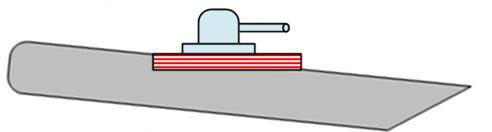
In this manner, aiming the gun is greatly simplified as it is mounted on a stable rather than a moving platform. But what if the stabilization system fails? Aiming of the gun must include anticipation and compensation for ship movements in addition to the target movements.
Biological stabilization systems use reflexes that sense unintended movement and countervail it by executing muscle memories. Limbs are maintained in a stable and ready to respond state by opposing stretch reflexes that alternately contract muscles causing the limb to oscillate about an intentional position. Normal tremors are hardly perceivable, large tremors are deficit and often simply referred to as tremor. Balance is maintained by reflexes in response to vestibular sensors that detect imbalance and cause muscle contractions to dynamically align the center of gravity over the base of support. Whereas neuroscience often describes the purpose of the Golgi Tendon Organ is to prevent excessive muscle contractions for the protection of muscles and tendons, it is hypothesized herein, to serve the vital purpose of maintaining muscle contraction forces to countervail muscle loads that would cause unintentional movement.
Reflexes do more than protect, they provide stabilization
Motor skills are extremely difficult to maintain when stabilization systems become deficit. A person with tremor, rigidity, imbalance, or inability to automatically sense and respond to unintended movement may practice motor skills and never achieve adequate performance.
Movement is a system wherein reflex and voluntary movements interact with each other, share mechanisms and interface with other systems. For example, walking is voluntary, intentional movement, the execution of multiple voluntary muscle memories that 1. Continuously change the center of gravity, the size and position of the base of support, and their relationship to each other, thereby perturbing balance effectuating balance reflexes, 2. Reposition limbs that effectuate stretch reflexes, and 3. Shift weight that effectuates muscle tension reflexes. Walking would be countervailed, opposed, by reflexes, but for the system’s ability to distinguish between forces caused by intentional movement which are not to be countervailed, and forces caused by perturbations to stabilization which are to be countervailed. The same is true for all movements. For example, balance reflexes may cause postural changes effectuating stretch and tension reflexes that would attempt to countervail balance movements but for selective countervailing. Balance movement is not countervailed by the other reflexes whilst perturbations to stabilization are. Furthermore, all movements share vital components. For example, the same neurons, interneurons, proprioceptors, and muscles used for stabilization are used to plan and execute voluntary movement. It should come as no surprise that deficits anywhere in the system, especially in proprioceptors, adversely affect all movements.
Movement is a system of many moving and interacting parts
STABLEX STRATEGY
While other therapies mitigate symptoms by temporarily interfering with or disabling natural processes, STABLEX corrects the cause by restoring natural mechanisms to normal environments. STABLEX is a drug-free, non-invasive, motor skill trainer that has only positive side effects.
STABLEX – The first therapy to restore systemic, persistent, stable movement
STABLEX is designed to specifically train and thereby restore reflex stabilization muscle memories thereby providing a stable platform upon which voluntary muscle memories are restored.
Restore aberrant muscle memories that cause movement disorders
Voluntary Muscle Memories may be described as voluntary movements that are formed, remembered and improved with practice.
Practice makes perfect
Reflex muscle memories can also be improved with practice. However, whereas there is a plethora of training methods, devices, and treatments to improve, supplement, substitute or cope with deficit voluntary muscle memories, essentially none exist for reflex muscle memories.
Develop training specifically for reflex muscle memories
Furthermore, voluntary muscle memories respond to conscious decision and reflex muscle memories respond to stimulus of proprioceptors that are sensory neurons unique to movement.
Stimulate proprioceptors the way they are designed to be stimulated
Train Reflexes
There are two basic versions of the STABLEX apparatus. A hand-held device and a wearable device that is firmly attached to a user’s torso. Both configurations have adjustable parameters including movement frequency, amplitude, and rotational direction. Both may be positioned to target reflexes. For example, the handheld unit directs the movement via prescribed exercises, and the wearable unit may be positioned relative to the user.
The STABLEX apparatus delivers repetitive forced movement that stretches muscles effectuating stretch reflexes, perturbs balance effectuating balance reflexes, and varies the load on muscles causing tension reflexes. The apparatus provides:
- Perturbations that cause stretch, balance, and muscle tension reflexes, under challenging conditions, to practice their ability to countervail unintended
- Movements are set to the reflex frequency to entrain, summate and thereby amplify reflex movement.
- Movements are symmetrically correct replicas of the aberrant reflex movement, an ideal movement, to guide and train the timing, strength, and balance of opposing muscle contractions.
- Movements that cause repetitive stabilization practice, at the optimum high rate, and for protracted periods.
Referring to Figure 1, the desired summation occurs when the STABLEX and tremor frequencies and phase are the same. The resultant movement, bottom trace, is the sum of both movements.
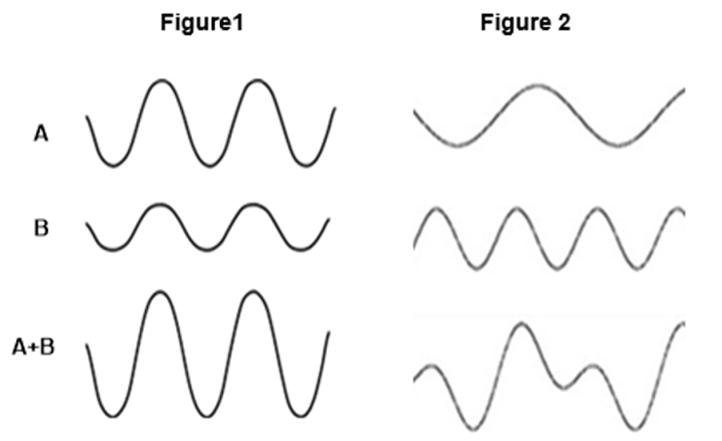
Referring to Figure 2. When the movement frequencies differ, the resultant movement will be a complex summation of forces. Figure 2 shows the summation of 2 frequencies, one of which is twice the other. The resultant wave form is not a replica of the tremor and would be further distorted if the frequency amplitudes were different. Every summation of 2 forces occurring at different frequencies and amplitudes will yield a complex movement.
Figure 2
If the perturbation frequency is greater than the tremor frequency, both opposing muscles will experience tetanic muscle contraction. The muscles do not have time to fully relax before being called upon to contract again. Movement becomes erratic, ceases, or becomes rigid.
The intent is to practice the reflex movement, not a derivative movement that can do more harm than good
Note: Interestingly, whereas vibration has been thought to mitigate movement disorders for 150 years, its effectiveness has been limited because the applied vibration was never synchronized to the tremor frequency, nor has it been a guiding ideal movement for reflex muscle memories to learn by.
Synchronize the frequencies
Train voluntary movement
Retrain aberrant voluntary movements that have adapted to an unstable platform to a stable platform. Voluntary movement and thereby the brain is relieved from having to compensate for defective stabilization. Movement is vastly simplified and improved whilst the brain is free to think.
Train the movement system
The movement system must function under environmental conditions it is designed to encounter. As movements interact with each other they should be practiced concurrently. Users may use the apparatus to train reflexes whilst performing normal daily activities or prescribed motor tasks to train voluntary movement. The best exercise to train ideal movement is ideal movement.
Train the system and the biological components will improve individually as needed, and in concert with each other
OPPORTUNITY
1. I am 89 years old and I need a partner, a successor, with financial and technological resources to carry STABLEX from my garage to the future.
2. The STABLEX device production model needs to be developed. I know what enhancements need to be incorporated to make it highly effective, automated, and flexible for future enhancements.
3. I need a partner, one who should be as shocked as I was with Dan’s discovery and see the same opportunities I saw.
Industry first – Paradigm Shift – Perhaps
You are invited to visit the website www.TREMOREX.com and contact me
ggcimo@sbcglobal.net with commentary, questions and/or challenges.